
ENT clinic software for findings, hearing tests and endoscopy
An ENT examination is a tour of small places, each with a side: the right eardrum, the left inferior turbinate, both tonsils. Tadawi's ENT workspace records every finding on its structure, with the audiogram and the endoscopy pictures on the same visit.
- 3D chart
- Audiograms
- Endoscopy media
- Surgical plans
Built for your specialty
What's built for Ear, nose & throat
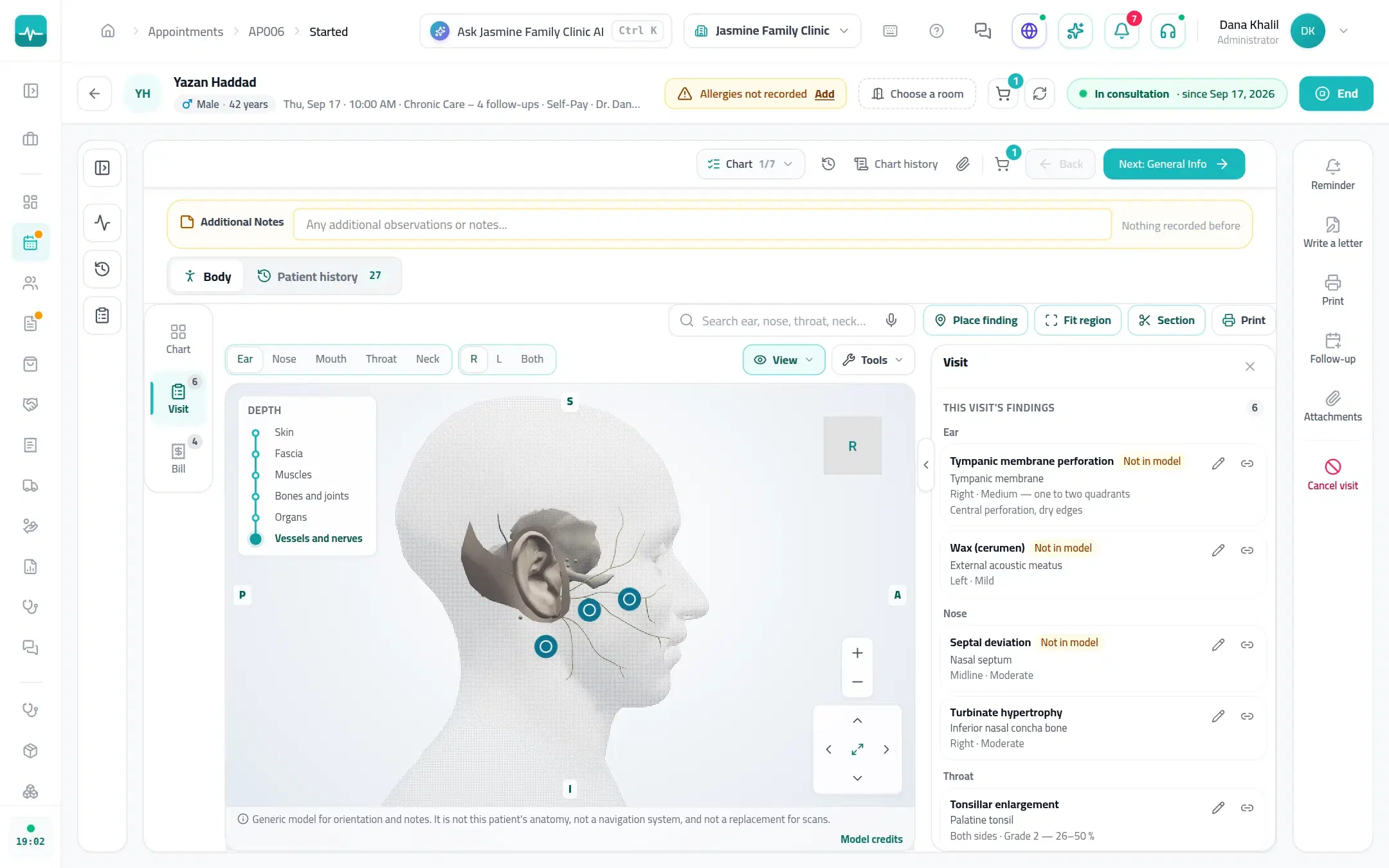
A 3D ENT chart
Ear, nose, mouth, throat and neck on a 3D head inside the visit. Choose a region and a side, cut a section through it, or search for “left eardrum”.
Findings with side and grade
50 finding types, from wax and perforation to septal deviation, polyps and neck masses. Each takes a side, a size and a grade, or a published scale such as Brodsky or House-Brackmann.
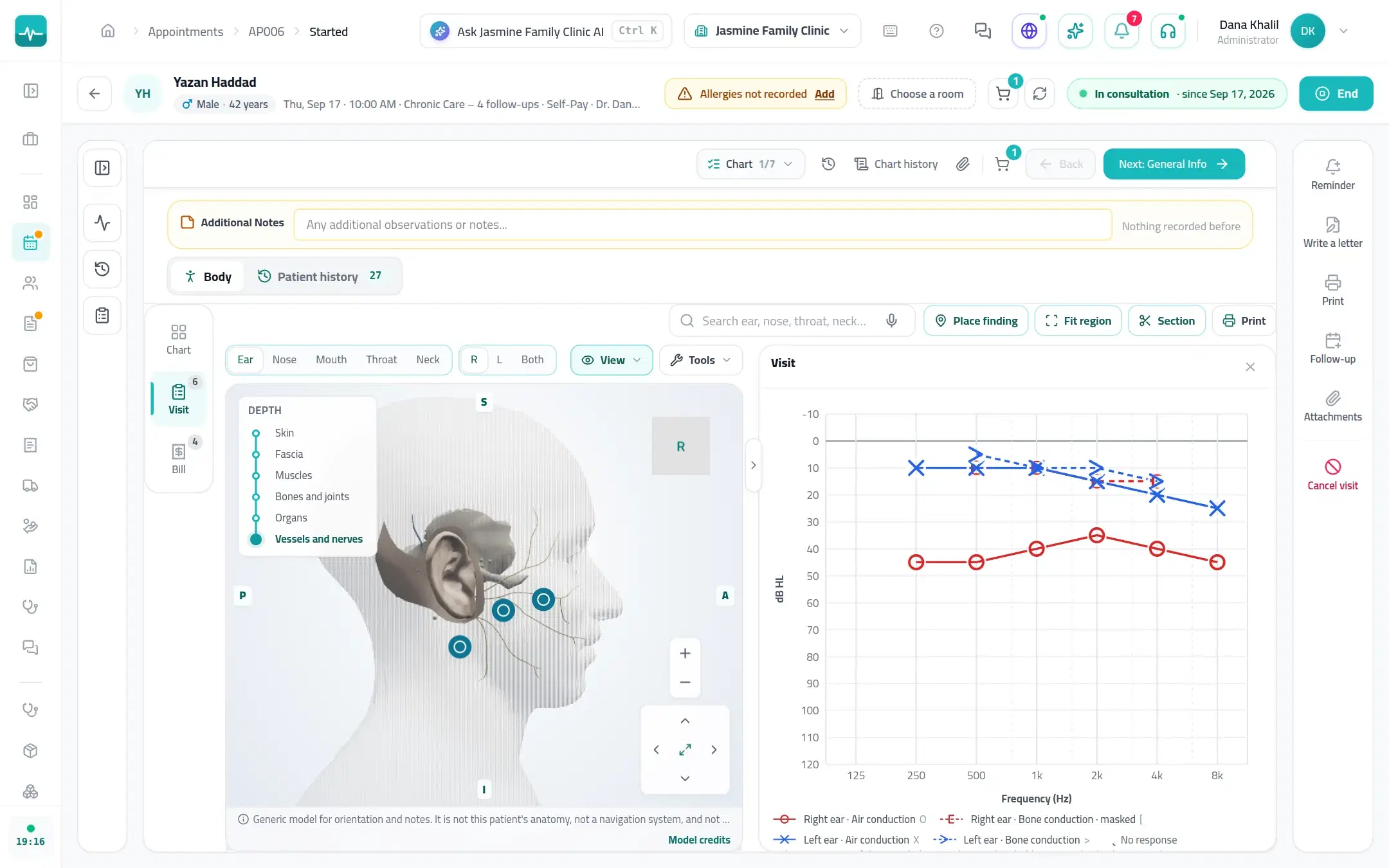
Audiograms and tympanometry
Type in air and bone conduction thresholds for each ear and Tadawi draws the audiogram with the usual symbols. Tympanograms keep the type, peak pressure, compliance and ear canal volume.
Endoscopy pictures and clips
Otoscopy, nasal endoscopy and laryngoscopy stills and clips, stored once consent is recorded and linked to the finding they show. The original file is always kept.
Procedures, plans and implants
Plan microsuction, nasal cautery or a tonsillectomy from the finding, and mark it done in the visit so it reaches the bill. Surgical plans and implants stay on the record.
Signed, amended, printed
The physician signs the examination and it is locked. A later change is kept as an amendment, and the printed examination carries the findings, the threshold table and pictures of the chart.
Inside the Doctor Portal
What it looks like
Real Doctor Portal screens, shown with a demo patient.
Your clinic
What an ENT clinic needs from its software
Ear, nose and throat work is anatomy in small spaces, and almost every finding needs a side. A general note that says “ear discharge” loses which ear, how large the perforation was and what the other eardrum looked like. An ENT clinic also mixes very different visits in one morning: a child with adenoids and glue ear, a blocked nose, a hearing test, a hoarse voice, a lump in the neck. Much of the evidence is a measurement or a picture.
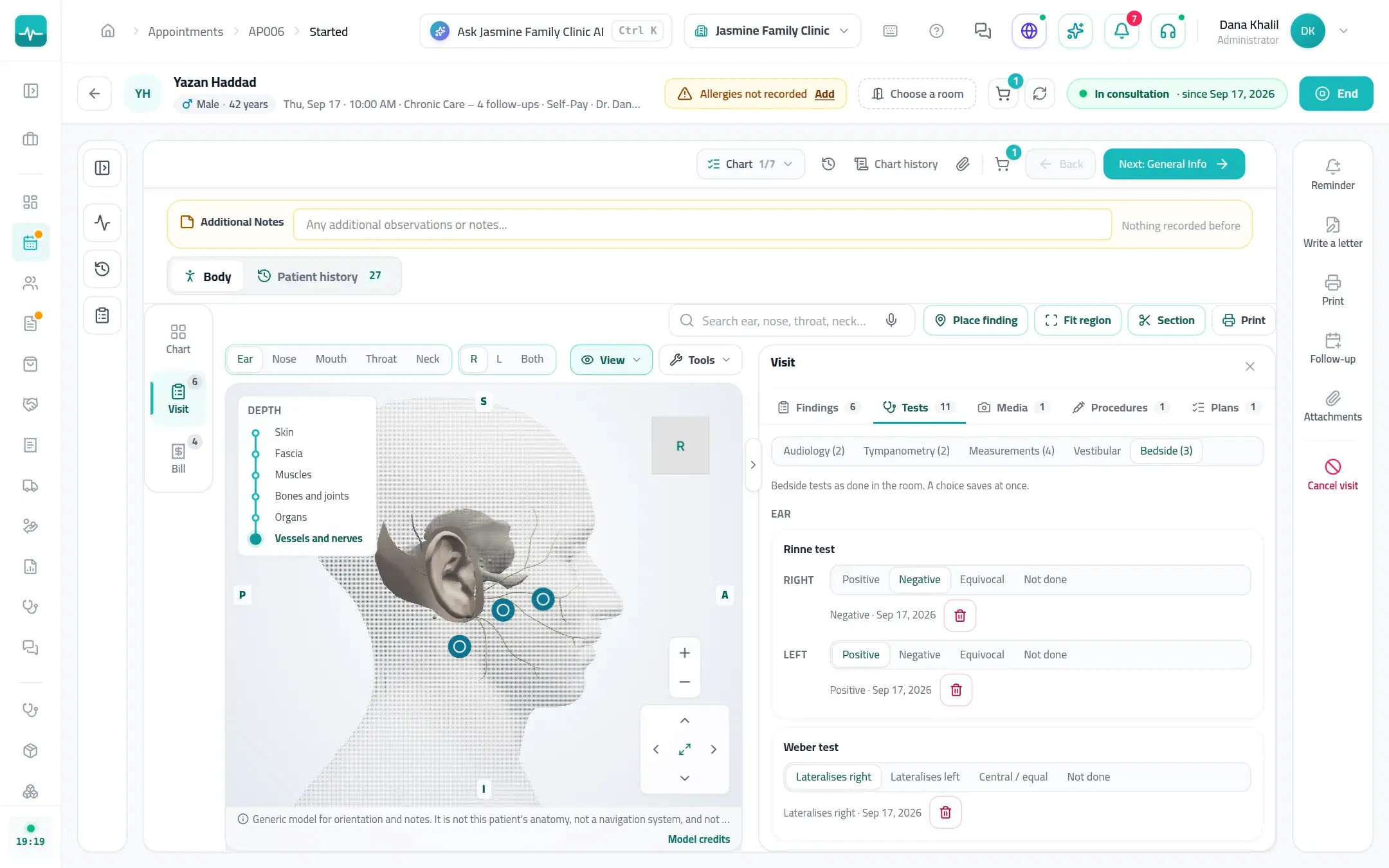
On Tadawi the ENT physician works on a 3D head and neck inside the visit. Pick the ear, nose, mouth, throat or neck, choose the side, and record what you see: tap a finding type, or type a line such as “left tonsil grade 3”. The audiologist or nurse enters the audiogram, the tympanometry and the bedside tests in the same visit, and those entries wait for the physician's review. Signing the examination copies the diagnoses linked to its findings to the visit.
Around the examination room, the clinic runs on the same system. The front desk books consultations, hearing tests and follow-up endoscopies as ordinary visits, sees who has been waiting longest, and takes payment. An insured patient's policy is picked at booking, so the invoice already knows the insurer's share. The owner opens a dashboard with the day's numbers. Every screen is available in both of the system's languages, Arabic and English, and Tadawi is used by clinics in Jordan and Iraq.
What you record
What you record in an ENT visit
The ENT workspace uses an otolaryngologist's words. These are the records it keeps for each patient, visit after visit.
- Complaint and examination notes
- The chief complaint with its side, and a note for each part of the examination: ears, nose, oral cavity and oropharynx, larynx and hypopharynx, neck, and cranial nerves.
- Findings on the structure
- Otitis externa, tympanic membrane perforation or retraction, middle ear effusion, turbinate hypertrophy, tonsillar enlargement, vocal fold lesions and thyroid nodules, each with its side, a size in millimetres, the onset and a note.
- Grading scales
- Brodsky for the tonsils, House-Brackmann for the facial nerve, Mallampati, Cotton-Myer for subglottic stenosis, Lund-Kennedy for nasal endoscopy and Sadé for retraction, each shown with its source.
- Pure-tone audiograms
- Air and bone conduction for each ear from 125 Hz to 8 kHz, masked thresholds and no-response marks, with the method and the tester. Overlay both ears, or compare with an earlier audiogram.
- Tympanometry and speech tests
- Tympanogram type A, As, Ad, B or C with peak pressure, static compliance and ear canal volume, plus speech reception threshold, word recognition, otoacoustic emissions and ABR threshold.
- Bedside and vestibular tests
- Rinne, Weber, whispered voice, Dix-Hallpike, head impulse, Romberg and the Cottle manoeuvre. A vestibular report such as VNG or caloric testing is kept as the result written and the interpretation given.
- Otoscopy and endoscopy media
- Stills and clips from otoscopy, nasal endoscopy, nasopharyngoscopy, laryngoscopy and stroboscopy. Consent is recorded once on the patient's file, and an annotated copy is stored beside the untouched original.
- Procedures, surgical plans and implants
- Clinic procedures and operations from a list of 34 types, planned first and marked done when they happen. Ventilation tubes, cochlear implants and prostheses keep their maker, model, serial and lot numbers.
- Prescriptions, letters and follow-up
- Ear drops and nasal sprays on a prescription you print or send by WhatsApp, a referral or medical report with your signature and a QR code, and the post-operative check booked before the patient leaves the room.
A visit, step by step
How a visit runs
Book
The front desk books the consultation or the hearing test, or the patient books on Tadawi Connect.
Test
The audiologist or nurse enters the audiogram, the tympanogram and the bedside tests, ready for the physician to review.
Examine and record
Pick the region and the side on the 3D chart, record the findings, add the endoscopy pictures, and plan or carry out procedures.
Sign, bill and follow up
Sign the examination, print it or write a letter, invoice the procedures done, and book the next visit.
Billing
Billing an ENT clinic
An ENT clinic bills consultations, hearing tests, endoscopies and small procedures done in the room, and prepares operations that happen on another day. What is marked done on the chart is what reaches the invoice.
- Consultation, audiometry, tympanometry, endoscopy and microsuction each have a price in your clinic's own list
- A procedure planned in an open visit sits on that visit's bill as planned, and the same line becomes done when you mark it
- A cancelled procedure leaves the bill unless it was already invoiced
- The insurer's share is split from the patient's on the invoice, from the policy picked at booking
- Products such as ear plugs or hearing aid batteries can be sold from stock
- In Jordan, insurance approvals and claims can go through Hakeem, and invoices to JoFotara
On every Tadawi clinic
And everything else your clinic runs on
The specialty tools sit inside the same Tadawi every clinic uses.
- SchedulingDay, week and all-doctor views, drag to reschedule, and a timer on everyone waiting.
- Online bookingPatients find you on Tadawi Connect and book the times you open, or send a request you approve.
- AI in the visitDictate the visit and get a safety check on allergies, duplicates and doses before you prescribe (on plans with AI).
- Prescriptions and lettersPrint or send prescriptions, sick leave and letters with your signature and a QR code to check them.
- Invoices and insuranceInvoices, payments and the insurer's share on the visit, plus packages, expenses and supplier bills.
- WhatsApp in one tapReminders, prescriptions and plans from ready templates, sent from the visit (on plans with WhatsApp).
Questions about Tadawi for Ear, nose & throat
Run your clinic on Tadawi
Set up online, or book a demo and we'll walk you through it with cases like yours. Tadawi switches the specialty tools on for your team.